Showing posts with label aid. Show all posts

Sunday, April 14, 2013

Vranckx: Kinderarbeid op cacaoplantages in Ivoorkust (Canvas)


Zelfs 3 jaar na de beloftes van grote chocoladefabrikanten blijft kinderarbeid schering en inslag op cacaoplantages in Ivoorkust.

Dit is een reportage van de Deense journalist Miki Mistrati en werd uitgezonden in het Canvas-programma 'Vranckx: Chocolade, nog steeds bitter?' op 30 maart 2013.

Meer:

Thursday, November 15, 2012

How Arunachalam Muruganantham started a sanitary napkin revolution! (TED talk)


"If anyone runs after money, their life will not have any beauty. It is boredom. A lot of people making a lot of money, billion, billions of dollars accumulating. Why are they coming for, finally, for philanthropy? Why the need for accumulating money, then doing philanthropy?

What if one decided to start philanthropy from day one?"
From TED.


More:

Tuesday, October 9, 2012

“Underwrite the poor like we underwrote the banks”

“Underwrite the poor like we underwrote the banks” – UN experts propose Global Fund for Social Protection

[9 October 2012] GENEVA/NEW YORK – “Nearly 80 percent of the world’s poor do not have access to social protection to shield them from the effects of unemployment, illness, or disability – not to mention crop failure or soaring food costs. Yet, if we were to dedicate 2 percent of global GDP to securing this human right, basic social protection could be provided to all of the world’s poor,” stated Olivier De Schutter, the UN Special Rapporteur on the right to food, and Magdalena Sepúlveda, the UN Special Rapporteur on extreme poverty and human rights.

Tuesday, June 19, 2012

Bottom Billion: conclusions

Three central propositions that encapsulate how thinking needs to change:
  1. The development problem we now face is not that of the past forty years: it is not the five billion people of the developing world and the Millennium Development Goals that track their progress. It is a much more focused problem of around a billion people in countries that are stuck. This is the problem we are going to have to tackle, and if we stick with present efforts, it is likely to be intractable even as the dashboard indicators of world poverty get better and better.
  2. Within the societies of the bottom billion there is an intense struggle between brave people who are trying to achieve change and powerful groups who oppose them. The politics of the bottom billion is not the bland and sedate process of the rich democracies but rather a dangerous contest between moral extremes. The struggle for the future of the bottom billion is not a contest between an evil rich world and a noble poor world. It is within the societies of the bottom billion, and to date we have largely been bystanders.
  3. We do not need to be bystanders. Our support for change can be decisive. But we will need not just a more intelligent approach to aid but complementary actions using instruments that have not conventionally been part of the development armory: trade policies, security strategies, changes in our laws, and new international charters.
We need to narrow the target and broaden the instruments. 
-- "The Bottom Billion" by Paul Collier, p. 192

Collier on the role of economic growth

"Growth is not a cure-all, but the lack of growth is a kill-all."
-- "The Bottom Billion" by Paul Collier, p. 190

Aid as a pyramid game

Theory development led to what Schumpeter calls 'the pedestrian view that capital per se propels the capitalist engine'. The West started thinking that by sending capital to a poor country with no entrepreneurship, no governmental policy and no industrial system, they could produce capitalism. The consequence is that today we virtually stuff money down the throat of countries with no productive structure - where this money could be profitably invested - because they are not allowed to follow the industrial strategy all the presently rich countries followed. 
Developing countries are given loans they cannot profitably utilize, and the whole process of development financing becomes akin to that of chain letters and pyramid games. Sooner or later the system breaks down, and the ones who designed it, standing close enough to the door when everybody rushes out, are able to make good financial profits, while the poor countries themselves are the losers. This is part of the mechanism that often creates larger flows of funds from the poor to the rich countries than the other way around, one of Gunnar Myrdal's 'perverse backwashes' of poverty. 
-- "How Rich Countries Got Rich" by Erik S. Reinert p. 124


More:

Wednesday, April 18, 2012

"Shop till it stops!"

Taken from Brand Aid
The following article is an extended reading list following the seminar "Consumer-behavior and funds to fight AIDS in Africa":

Sunday, March 11, 2012

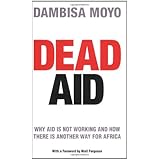
Dead Aid: counter proposal


What if, one by one, African countries each received a phone call, telling them that in exactly five years the aid taps would be shut off - permanently? Although exceptions would be made for isolated emergency relief such as famine and natural disasters, aid would no longer attempt to address Africa's generic economic plight.

Would many more millions in Africa die from poverty and hunger? Probably not - the reality is that Africa's poverty-stricken don't see the aid flows anyway. Would there be more wars, more coups, more despots? Doubtful - without aid, you are taking away a big incentive for conflict. Would roads, schools and hospitals cease being built? Unlikely.

Isn't it likely that in a world freed of aid, economic life for the majority of Africans might actually improve, that corruption would fall, entrepreneurs would rise, and Africa's growth engine would start chugging?

-- Dambisa Moyo, Dead Aid

Moyo her scenario is thought-provoking. In the end, we all want to see a world that no longer depends on aid, right? That is the goal of all development, right?

Unfortunately she oversimplifies the complexity of development, measuring a country's welfare only through GDP and economic growth is shortsighted and is limiting the world to a purely economic model. Development goes much further than that.

My counter proposal is defined in the following five steps. It will demand a different view on the economic ties between Africa and the donor countries, especially where I ask to get rid of all outstanding (development) debt, but this is the only way to make the governments accountable again. Not accountable to their creditors, but to their own people.

  1. abolish all outstanding debt accumulated by loans in name of 'aid' (and their compound interest)
  2. stop putting pressure on countries to 'open their markets' or 'limit government interference'.
    If a country is interested in following this policy, it should be allowed to do so at its own pace
  3. governments should be accountable to their citizens (not to donors)
  4. aid in form of knowledge, experience and/or technology should always be provided
  5. the decision whether a project is in need of additional financial aid (outside of the local government) should be looked into on project level
More:

Friday, March 9, 2012

Dead Aid?


Dambisa Moyo, international economist and best-selling author, discusses in her book Dead Aid (2009) whether aid is actually making Africa's situation worse.

In her speech at the Brussels TEDx of 2009, she stresses that in the book she is not talking about emergency aid (like the Tsunami Relief or similar fundraisings), although even those "can be commented on", but purely about the structural aid that has been poured into Africa for decades.

If we generalize, then at this moment there are two main ideas: at one side we have aid advocates as Jeffrey Sachs (The End of Poverty) and aid critiques at the other.

The interesting part of Moyo her book is the thesis that aid is corrupting and depriving the citizens of a country to hold their (aid-dependent)  government accountable.

In a 'normal' society,  the government is responsible for upholding law and providing public goods like education, social welfare, ... but also infrastructure for roads, electricity and so forth. As these public goods are now mostly provided through aid (and as the donors provide the money, they can enforce their power and their wishes), there is hardly anything left to keep the government accountable for. Then what is the motivation for people to elect a government? It will less and less be about 'good governance' (because that is what foreign aid providers will take care off) and more and more about nepotism.

Where I don't agree with Moyo, is that the book measures a country's development purely and only in GDP and economic growth. This is a simplistic way of looking at social implications. An economist is tended to think that way, but development goes far beyond that. GDP can even give a distorted view as it does not hold the inequality ratio amongst the population into account.

It is good that the book brings aid to discussion again, it is a provocative statement and challenges us to think about the definition and goals of aid. As I agree with the necessary accountability of a government, I am fundamentally opposed to limit our observations of development to GDP and economic growth. It is oversimplifying.

But indeed, it should be carefully discussed and looked into where aid funding is needed and where not. As 'possible aid providers', we should not be paternalistic or condescending, but have a clear understanding of the needs and interests of the possible beneficiaries. It is plainly shocking that in the majority of funding programs in the West, we mostly see white, rich males explaining us why Africa should need aid and that is purely bizarre as the African intellect should be encouraged. 


Other critiques on Dead Aid:

[Moyo] ignores the fact that aid was only provided when countries meet requirements that restricted their own economy. Systematically pruning the government spending, privatizing and unmonitored opening of their markets for producers where developing countries bcan't compete with, one of the major causes for the current problems of Africa.
[...] When you want to address poverty, working on these root causes are the main assignment. If you don't do that, all the aid in the world won't have any effect on the development, but that doesn't mean that aid in itself would be useless.
 [...] Aid alone is not sufficient to solve Africa's problems. Aid is a catalyst which can enstrengthen the development. That can only happen when the right climate is present, both internal as external.
Bogdan Vanden Berghe from the Flemish umbrella organisation '11 11 11' in "Don't blame aid" (article written in Dutch)

Her alternative (more free market, more trade with Asia than with Europe and the USA, more capitalism) is not very credible. But her analysis gets down to brass tacks. Every road constructed in Africa by the World Bank (or China), every hospital being furnished or every school built with foreign money, dismisses the local potentates of their responsibilities to do it themselves and therefore maintains the corruption.
Walter Zinzen, Belgian journalist: "Stop development aid" in De Standaard (article written in Dutch)

[...] we should question the quality of "growth", because basically we have a growth model that does not work for the majority of the people in the world. What we have in the world today is called "jobless growth" and "growth without equity". 
In fact the growth that we have, particularly since the fall of the Berlin wall, when we have a surge of neoliberalism, we have seen actually virtually in every single country in the world the gap between rich and poor growing at an astronomical rate, and also the gap between rich and poor countries growing quite fundamentally. So when we talk about redifining development, we have to basically say that there are no holy cows and in that case, in that sense I think that Moyo her book is helpful as it makes a provocative statement. 
While I disagree with the conclusion of it, some of the observations are obviously helpful.
Kumi Naidoo, South African human rights activist: debate with Dembisa Moyo

Links:


in Dutch:

  • Dead Aid: Why aid in Africa doesn't work (Waarom ontwikkelingshulp in Afrika niet werkt, EcoCafe)
  • The reality is more complex than Moyo's oneliners (De realiteit is complexer dan de oneliner van Moyo, MO*Lezing, 18 September 2009)
  • Is aid responsible for the poverty in Africa? (Is ontwikkelingshulp verantwoordelijk voor de armoede in Afrika?, MO*paper, 18 September 2009)
  • Caveat for discussion on aid (De valkuil van de hulpdiscussie, MO, 26 October 2009)
  • Aid doesn't bring development (Hulp brengt geen ontwikkeling MO on MDGs, 8 September 2010)
  • Don't cut on solidarity! (Bespaar niet op solidariteit!, 11.11.11, 2 October 2009)
  • More money alone can't make us achieve the Millennium Development Goals (Meer geld alleen kan Millenniumbeloften niet inlossen, MO on MDGs, 20 September 2010)
  • Should we stop providing development aid? (Moeten we stoppen met het geven van ontwikkelingshulp?, NRC Handelsblad, 21 March 2009)
  • Market and aid need each other (Markt en hulp hebben elkaar nodig, Petra Kroon)

More:

Wednesday, September 21, 2011

Ending Aid Dependence

Cover of the book
by Yash Tandon

During my visit to Norway, I followed some classes of International Development Studies. I am very much interested in the topic, also because I have some experience with life in Ghana (both as a volunteer and a business owner).


To me, it is clear that 'aid' as the concept that we understand (or use) it today, is not working.


Good books on this topic are:

Related Posts Plugin for WordPress, Blogger...