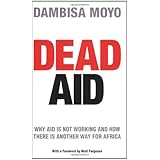
Dambisa Moyo, international economist and best-selling author, discusses in her book
Dead Aid (2009) whether aid is actually making Africa's situation worse.
In her
speech at the
Brussels TEDx of 2009, she stresses that in the book she is not talking about emergency aid (like the Tsunami Relief or similar fundraisings), although even those "can be commented on", but purely about the structural aid that has been poured into Africa for decades.
If we generalize, then at this moment there are two main ideas: at one side we have aid advocates as Jeffrey Sachs (The End of Poverty) and aid critiques at the other.
The interesting part of Moyo her book is the thesis that aid is corrupting and depriving the citizens of a country to hold their (aid-dependent) government accountable.
In a 'normal' society, the government is responsible for upholding law and providing public goods like education, social welfare, ... but also infrastructure for roads, electricity and so forth. As these public goods are now mostly provided through aid (and as the donors provide the money, they can enforce their power and their wishes), there is hardly anything left to keep the government accountable for. Then what is the motivation for people to elect a government? It will less and less be about 'good governance' (because that is what foreign aid providers will take care off) and more and more about nepotism.
Where I don't agree with Moyo, is that the book measures a country's development purely and only in GDP and economic growth. This is a simplistic way of looking at social implications. An economist is tended to think that way, but development goes far beyond that. GDP can even give a distorted view as it does not hold the inequality ratio amongst the population into account.
It is good that the book brings aid to discussion again, it is a provocative statement and challenges us to think about the definition and goals of aid. As I agree with the necessary accountability of a government, I am fundamentally opposed to limit our observations of development to GDP and economic growth. It is oversimplifying.
But indeed, it should be carefully discussed and looked into where aid funding is needed and where not. As 'possible aid providers', we should not be paternalistic or condescending, but have a clear understanding of the needs and interests of the possible beneficiaries. It is plainly shocking that in the majority of funding programs in the West, we mostly see white, rich males explaining us why Africa should need aid and that is purely bizarre as the African intellect should be encouraged.
Other critiques on Dead Aid:
[Moyo] ignores the fact that aid was only provided when countries meet requirements that restricted their own economy. Systematically pruning the government spending, privatizing and unmonitored opening of their markets for producers where developing countries bcan't compete with, one of the major causes for the current problems of Africa.
[...] When you want to address poverty, working on these root causes are the main assignment. If you don't do that, all the aid in the world won't have any effect on the development, but that doesn't mean that aid in itself would be useless.
[...] Aid alone is not sufficient to solve Africa's problems. Aid is a catalyst which can enstrengthen the development. That can only happen when the right climate is present, both internal as external.
Bogdan Vanden Berghe from the Flemish umbrella organisation '11 11 11' in "Don't blame aid" (article written in Dutch)
Her alternative (more free market, more trade with Asia than with Europe and the USA, more capitalism) is not very credible. But her analysis gets down to brass tacks. Every road constructed in Africa by the World Bank (or China), every hospital being furnished or every school built with foreign money, dismisses the local potentates of their responsibilities to do it themselves and therefore maintains the corruption.
Walter Zinzen, Belgian journalist: "Stop development aid" in De Standaard (article written in Dutch)
[...] we should question the quality of "growth", because basically we have a growth model that does not work for the majority of the people in the world. What we have in the world today is called "jobless growth" and "growth without equity".
In fact the growth that we have, particularly since the fall of the Berlin wall, when we have a surge of neoliberalism, we have seen actually virtually in every single country in the world the gap between rich and poor growing at an astronomical rate, and also the gap between rich and poor countries growing quite fundamentally. So when we talk about redifining development, we have to basically say that there are no holy cows and in that case, in that sense I think that Moyo her book is helpful as it makes a provocative statement.
While I disagree with the conclusion of it, some of the observations are obviously helpful.
Kumi Naidoo, South African human rights activist: debate with Dembisa Moyo
Links:
in Dutch:
- Dead Aid: Why aid in Africa doesn't work (Waarom ontwikkelingshulp in Afrika niet werkt, EcoCafe)
- The reality is more complex than Moyo's oneliners (De realiteit is complexer dan de oneliner van Moyo, MO*Lezing, 18 September 2009)
- Is aid responsible for the poverty in Africa? (Is ontwikkelingshulp verantwoordelijk voor de armoede in Afrika?, MO*paper, 18 September 2009)
- Caveat for discussion on aid (De valkuil van de hulpdiscussie, MO, 26 October 2009)
- Aid doesn't bring development (Hulp brengt geen ontwikkeling MO on MDGs, 8 September 2010)
- Don't cut on solidarity! (Bespaar niet op solidariteit!, 11.11.11, 2 October 2009)
- More money alone can't make us achieve the Millennium Development Goals (Meer geld alleen kan Millenniumbeloften niet inlossen, MO on MDGs, 20 September 2010)
- Should we stop providing development aid? (Moeten we stoppen met het geven van ontwikkelingshulp?, NRC Handelsblad, 21 March 2009)
- Market and aid need each other (Markt en hulp hebben elkaar nodig, Petra Kroon)
More: